
Search
A Shepherd's Message - July 8, 2025
-
July 8, 2025
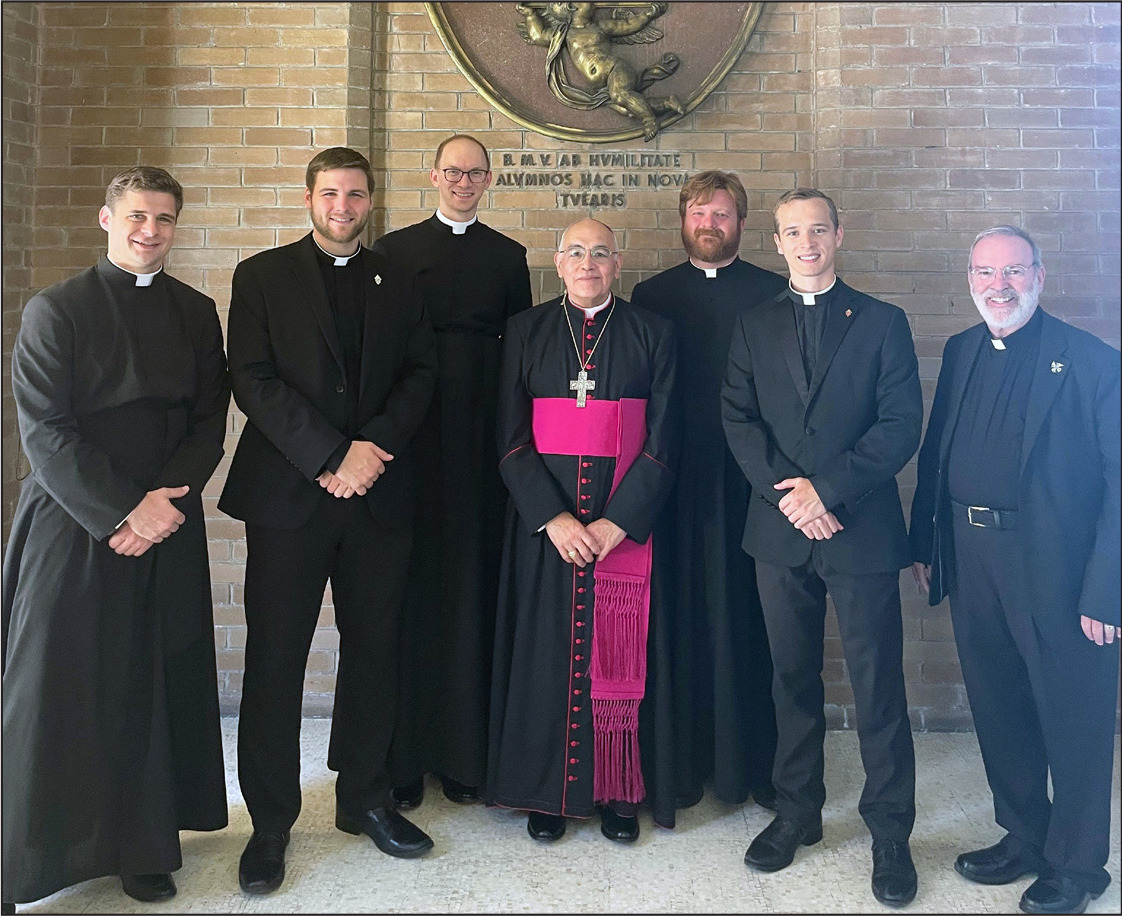
Archbishop Joe S. Vásquez, at center, met with Texas diocesan seminarians from Galveston-Houston and Austin studying at the Pontifical North American College in Rome alongside Father John Rooney, pastor of St. Mary of the Expectation in League City, and Father Joseph White, who serves as Archbishop's priest-secretary. (Photo courtesy of Father John Rooney)
You are among the eight U.S. Archbishops appointed by Pope Francis who received their palliums from Pope Leo XIV, who previously led the Dicastery for Bishops that helped Pope Francis make those appointments such as yours. When Pope Leo imposed the pallium upon you, what did it mean?
To me, the significance of receiving the pallium is important because it shows my communion and unity with the Holy Father as a sign of loyalty and fidelity to him as the successor of Peter. The pallium also emphasizes my responsibility as an archbishop. It signifies being a shepherd to the sheep that have been entrusted to my care. That’s a great responsibility that I take seriously. But it’s not only about me, but it’s also about the people whom I shepherd.
Part of the pallium has the marks (the nails) of Christ’s suffering as part of the vestment that’s placed upon you. This signifies the suffering that one has to undergo to be able to serve the people of God. As a bishop, I am to serve the people of God, even to the point of suffering for them, for their good, remembering Christ who suffered for us, out of love for the world. That’s my commitment to care for the flock entrusted to my care.
I’m grateful that I had this opportunity to be with Pope Leo XIV. I wanted to be part of this because it is such an important part of who I am now as an archbishop.
Had you met Pope Leo XIV before? How do you see the start of his pontificate and his messages of peace and unity?
No, I had not had the opportunity to meet him before, nor did I know him from his time serving as the Prefect of the Dicastery for Bishops. Obviously, the Holy Father had some influence on the late Pope Francis appointing me to Galveston-Houston.
The two themes of peace and unity that the Holy Father has highlighted are critical for our time. Why? There are many wars throughout the world, and these are critical events in our history. On June 25, the Holy Father mentioned, once again, that we cannot close our eyes to the suffering of our brothers and sisters who are experiencing war right now. He knows the suffering and pain that they’re experiencing; therefore, he wants us to be part of that and to say, “How do we help?” All of us should at least be praying for peace and continue to dialogue and build relationships with other people to bring about Christ’s peace.
These themes of peace and unity are central because we find ourselves in a country that is polarized, fractured and divided. The pope wants us to enter into dialogue with people, even those with whom we have differences, so that we can listen to one another. He seems to be a man who understands very clearly what it means to listen.
Were you able to join any Jubilee Year activities in Rome?
What a blessing! I was able to visit the Major Basilicas and walk through the Holy Doors. That was very emotional and touching for me. Not only going through the Holy Doors myself, but seeing all the pilgrims go through those doors and touching them in moments of prayer.
This was moving for me because the pilgrims have their own situations, coming from all parts of the world, and here they are in this beautiful city, the heart of the Church, united in their faith as Catholics. It’s wonderful to see young people, the elderly, couples, families and single people. We’re all on this journey of faith, and we’re all moving forward, and Christ is the one who keeps calling us forward. We are pilgrims of hope.