
Search
Popular poinsettia has faithful roots, meaning
-
December 22, 2025
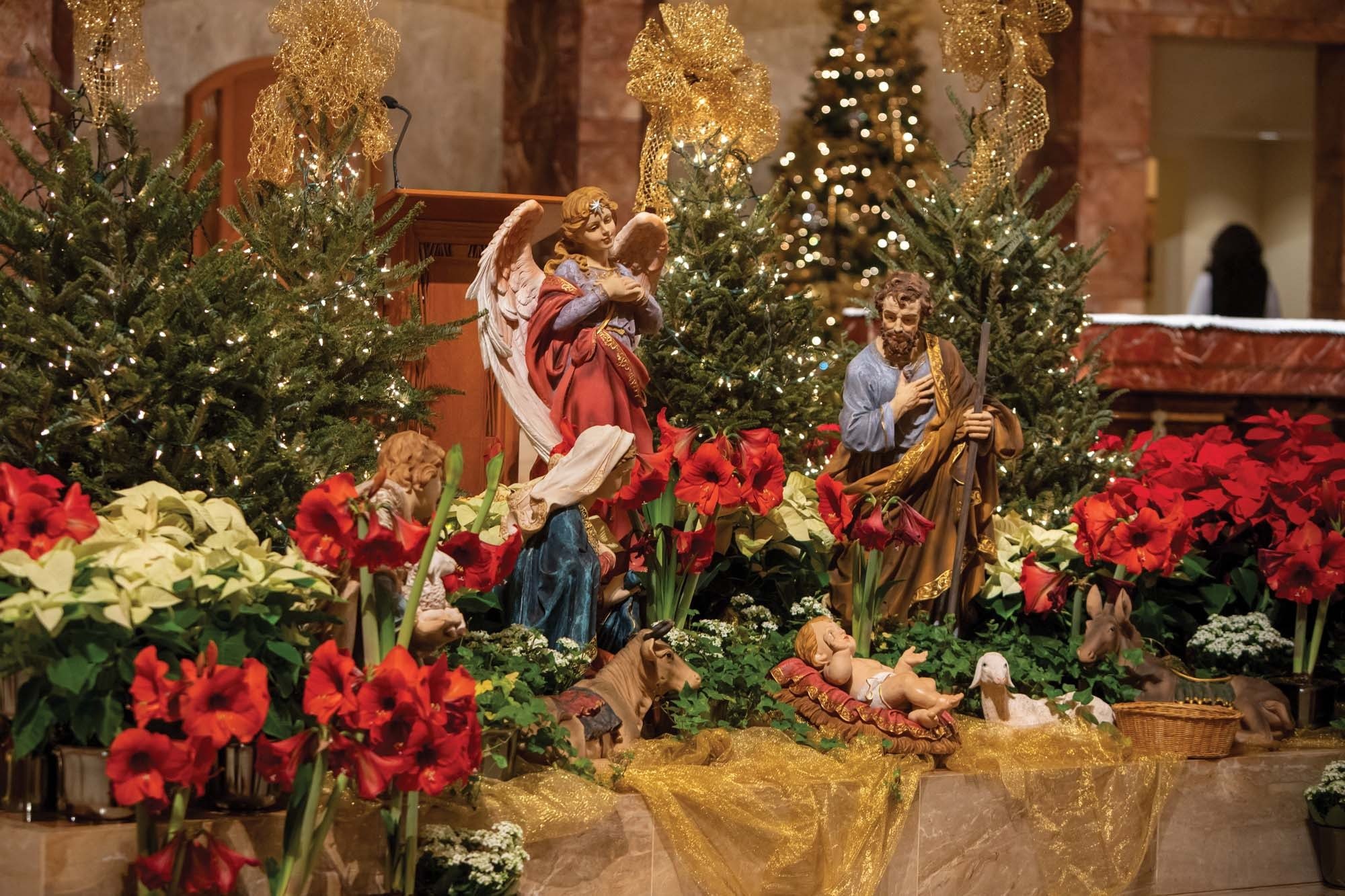 A nativity at the Co-Cathedral of the Sacred Heart incorporates evergreen fir trees (at back), white and red poinsettias (left and right, respectively), and red amaryllis throughout. (Herald file photo by James Ramos)
HOUSTON — It’s the most wonderful time of the year for many reasons, including the beautiful decorations that liven and brighten up churches, homes, stores, streetlamps and more.
With lights, ribbon and vibrant greenery, seasonal arrangements indicate that Christmas time is here. Certain flowers and plants are included in such displays and considered Christmas staples, with a history and care routine that explain why they’re a holiday classic.
On many steps leading up to the altar inside a church, poinsettias (Euphorbia pulcherrima) add a colorful red and green appearance. The subtropical plant native to Mexico has a legend that is attributed to its popularity during the yuletide.
According to Mexican lore, a child named Pepita was on her way to Christmas Eve Mass with her cousin Pedro. It was customary to bring a gift for the Christ child, but being poor, Pepita was unable to buy a gift.
Sweetly picking wildflowers on her way to Mass, she presented them at the nativity scene near the altar of the church. Having pity on Pepita, the angels transformed the weeds into fiery red flowers that looked ablaze like bright stars as everyone present gasped in wonder at the miraculous sight.
The starry structure of the plant is said to resemble the Star of Bethlehem. Its leaves, which create the starry outline, are bracts, and the flower is actually the small, yellowish cluster of buttons at the center of the bracts.
In Mexico, the poinsettia is referred to as Flor de la Noche Buena (Flower of the Holy Night, Christmas Eve). It is well-known for its festive red and green exterior, but the plant has over 200 colors and varieties, such as white, green, yellow and more combinations.
Brought to the U.S. in 1828 by Joel Roberts Poinsett, who was the first U.S. ambassador to Mexico and a botanist, he began to grow cuttings of the plant at his greenhouses in South Carolina after noticing its winter bloom in Mexico.
Long before it was brought to the U.S., the Aztecs used the plant for medicines, dyes and in religious ceremonies. It was called Cuetlaxochitl in the Nahuatl language, and Montezuma, the last Aztec emperor, would order droves of the Cuetlaxochitl as furnishings in his palaces at Tenochtitlan.
To care for the perennial shrub, keep it out of cold temperatures, as it is a tropical plant. Indirect sunlight for 6 hours is a healthy amount, while direct sunlight can cause the leaves to fade. Only water the plant when the potting mix is dry, and don’t let it sit in water because overwatering is a cause of death. Fertilizer is unnecessary while in bloom.
When arranging Christmas blends, red and white flowers go well together; pines and cedars mixed with white flowers make for quintessential greenery; add a candle with pinecones and amaryllis to create a wintery table centerpiece; and combine hellebores with greenery for a merry minimalist look.Flowers to remember for winter arrangements
For any array of traditional flowers, plants and trees to freshen up the Christmas and winter season, consider the following:- Amaryllis (Hippeastrum)
- Azaleas
- Balsam Fir (Abies balsamea)
- Blue Spruce (Picea pungens)
- Christmas Cactus (Schlumbergera x buckleyi)
- Christmas Rose (Hellebore niger)
- Cyclamen (Cyclamen persicum)
- Douglas Fir (Pseudotsuga menziesii)
- Gardenia (Gardenia jasminoides)
- Holly (Ilex opaca)
- Ivy (Hedera helix)
- Juniper (Juniperus occidentalis)
- Mistletoe (Phoradendron leucarpum)
- Moth Orchid (Phalaenopsis spp.)
- Paperwhites (Narcissus papyraceus)
- Pear Tree (Pyrus communis)
- Rosemary (Salvia rosmarinus)
- Snowdrops (Galanthus spp.)
- Wintergreen (Gaultheria procumbens)
- Winter Honeysuckle (Lonicera fragrantissima)
- Yew (Taxus spp.)
- Yuletide Camellia (Camellia Sasanqua ‘Yuletide’)