
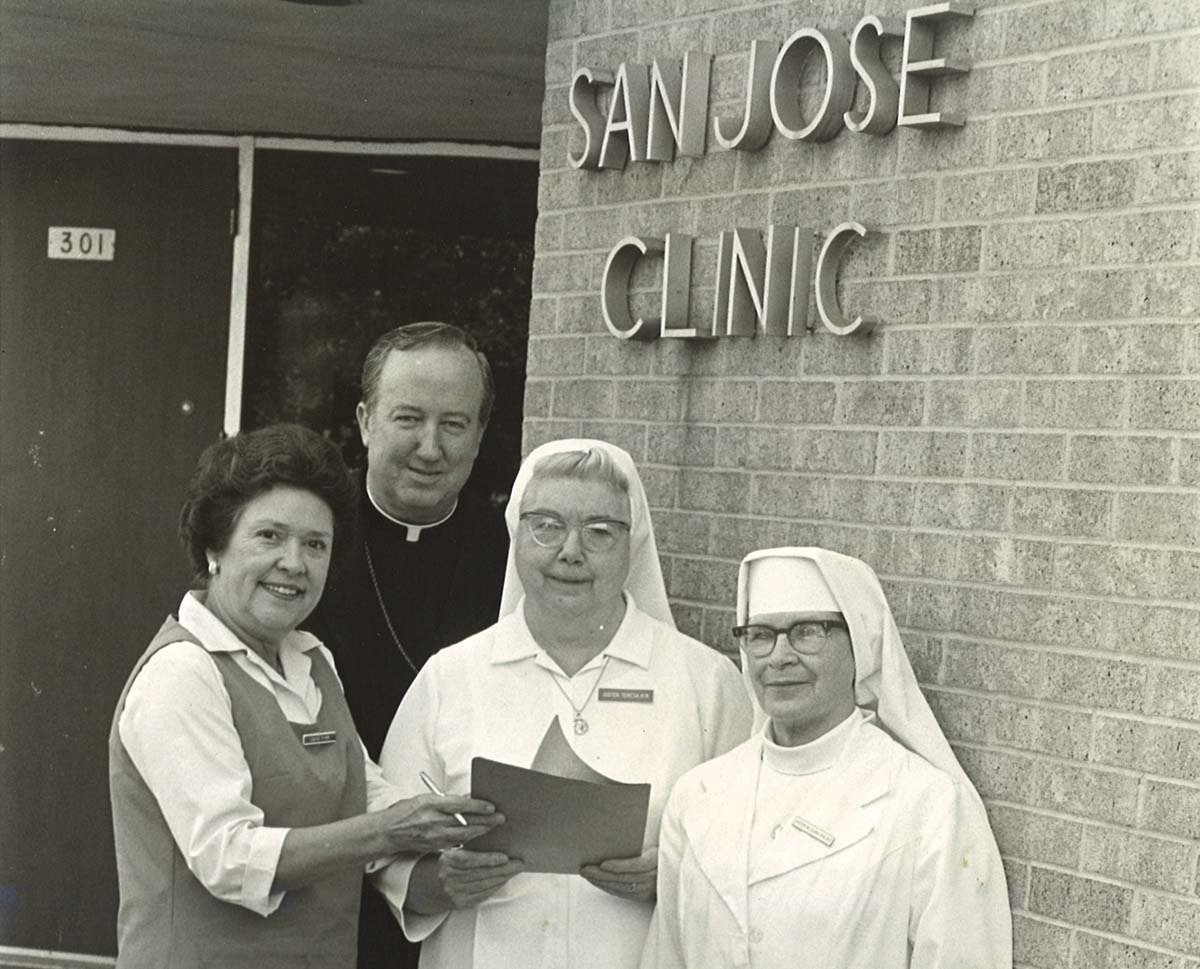
HOUSTON — When Monsignor George T. Walsh, then pastor of Annunciation Catholic Church in downtown Houston, learned of the high infant mortality of Mexican children in Houston in 1922, he knew where to turn.
A group of his parishioners had just started a new local chapter of the National Council of Catholic Women so Monsignor Walsh, with the approval of Bishop Christopher Byrne, asked the ladies to help.
Now known as the Charity Guild of Catholic Women, the local council president, Theodora Kendall, and clinic co-founder, Katherine Carroll, each pitched in one dollar and rallied 57 other council members to do the same.
With that seed money of $59, which in 2022 would have the purchasing power of $979, San José Clinic was born after going through several transformations.
First starting as Clinica Gratuita in a wood-frame house at 1900 Franklin Street, it was later renamed the Mexican Clinic when moved to Canal Street in Second Ward, then San José Clinic downtown on Hamilton and now San José Clinic is located in a modern office building in midtown at 2615 Fannin with an extension clinic in Rosenberg.
This year, both the clinic and the Charity Guild of Catholic Women are celebrating their 100 years serving the community, especially those below the poverty line or the working poor. Starting back at Annunciation Church where Monsignor Walsh’s brainchild was born, San José Clinic held its Centennial Anniversary Mass there on Jan. 22.
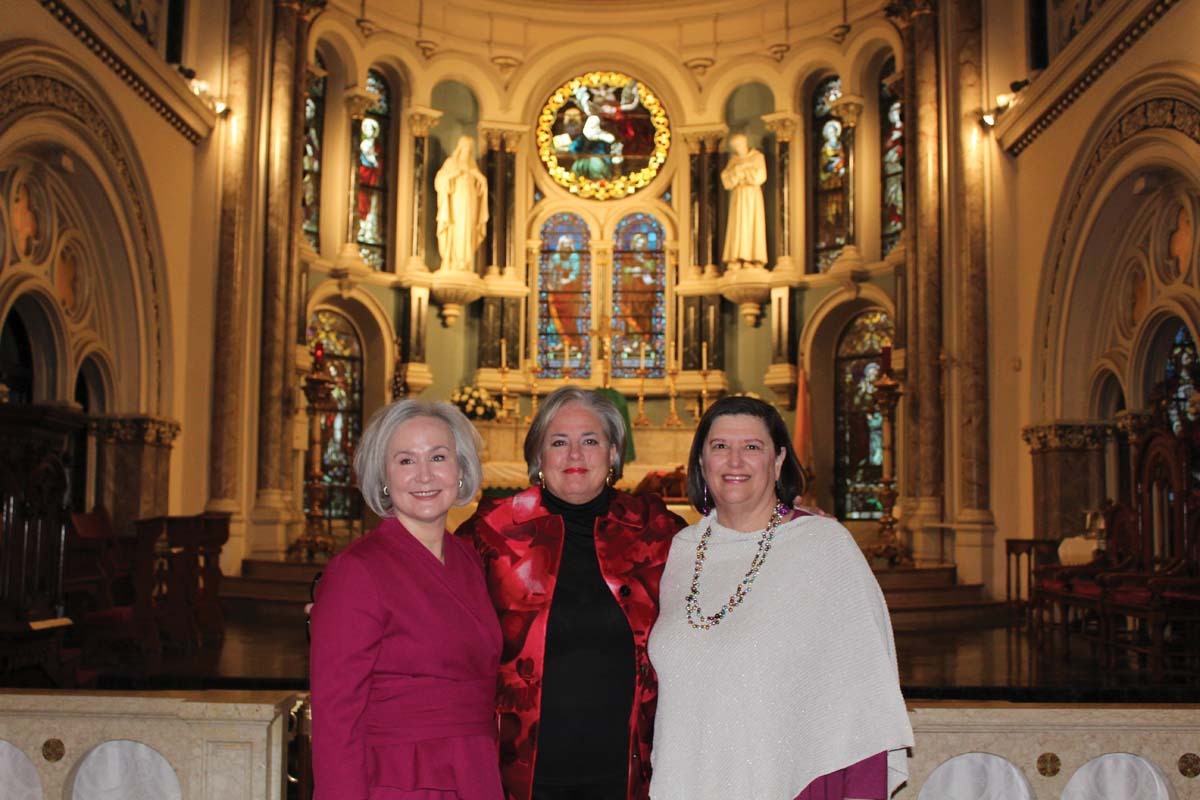 “We come here to celebrate the centennial anniversary of San José Clinic and its rich history of providing healthcare and hope to the marginalized within Houston since 1922,” Father Millette said in his homily. “It is fitting that we celebrate this event here in the place where it started 100 years ago when Monsignor George Walsh, at that time the pastor of Annunciation Church, enlisted the help of the Charity Guild of Catholic Women to create a clinic for the care of disadvantaged children.”
He added, “We see that we cannot honor San José Clinic without equally honoring all of those other people and institutions, known and unknown, who have made its work possible here in Houston for these past hundred years.”
“Within the pages of San José’s history, we read about the generous support from the Archdiocese of Galveston-Houston, religious sisters from congregations such as the Sisters of Immaculate Conception and Sisters of Charity of the Incarnate Word, the Charity Guild of Catholic Women, United Way, the Scanlan Foundation, Christus Health as well as many other health care and medical academic institutions throughout Houston, not to mention the innumerable volunteer doctors, nurses and dentists as well as everyone who has contributed or donated in any way,” Father Millette said.
He concluded, “We must not forget, however, that this mission is meant to bring about more than just physical healing. Recall that Jesus healed the sick as a sign of the deeper healing which He was bringing to the world, as an invitation to place faith in God and enter into the true joy of Heaven.”
While that spiritual component is an important part of the mission, the clinic serves all faiths and those with none.
San José Clinic President and CEO Maureen Sanders told a group of supporters attending the Mass and reception afterward, “These efforts, along with your prayers and continued support, serve the fourth largest city in America as the healthcare home for all of the underserved and uninsured in our community.”
In addition to the official kick-off with the Anniversary Mass, San José Clinic will celebrate special events each month of this year. “In the coming weeks and months, you will hear more about our parish outreach initiative within the Archdiocese,” she said.
Sanders said the outreach effort to parishes will partner with other ministries such as Catholic Charities and St. Dominic Village residences for the elderly. They plan to visit parishes to inform church-goers of the health care provided and other social services available to those eligible.
The clinic has been hard-hit by the COVID-19 pandemic, as many others have. In “normal” times, as many as 400 uninsured patients a day would come into the clinic to receive low-cost check-ups, dental care and medications to manage their illnesses.
Since recently reopening the doors at the clinic’s Fannin Street location, the patients are slowly returning in person, but telemedicine is also here to stay, said San José Clinic board chair Michelle Herrera.
“This situation has shown how incredibly nimble San José is even after 100 years. We knew this was an important moment in time to keep talking and seeing patients,” Herrera said. “Everyone kept working in concert whether at home and embraced what was needed with the blessings of Daniel Cardinal DiNardo.”
“Most of the populations we serve have two or three jobs to make it economically. So going forward, we need to be here for another 100 years to help those in need,” she said.
More than 50% of the clinic’s patients live at or below 100% of the federal poverty line, meaning less than $27,750 annually for a family of four. About 65% of their patients are women, and 75% of their clientele identify as Hispanic.
Cardiologist Dr. Carter Grinstead III won the clinic’s Volunteer of the Year award this year after serving patients there throughout the pandemic over the past two years.
“Many of the older medical staff had to take a hiatus when the virus hit. I was able to continue part-time seeing three to five patients in the afternoon, twice a week at the midtown clinic, and monthly at the Rosenberg clinic,” Dr. Grinstead said.
“Our patients deserve this kind of excellent care. They are good community residents who are mostly working but have no insurance,” he said. “They don’t feel entitled but are very appreciative.”
“I’m not Catholic. I’m with St. Luke’s Methodist Church. But it doesn’t matter which denomination you are at the clinic. We just want to help the community,” Dr. Grinstead said.