
Search
St. Newman’s proclamation as doctor of Church spotlights college Catholic ministries
-
November 10, 2025
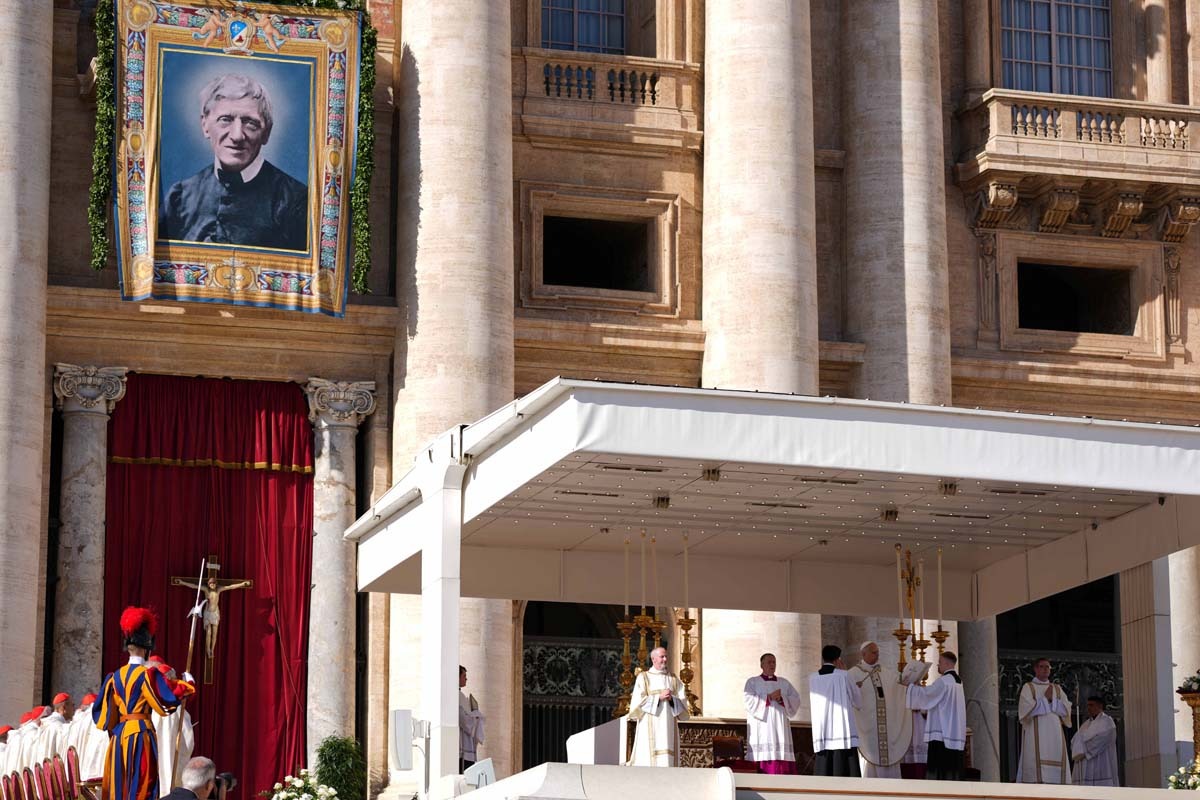 Pope Leo XIV celebrates Mass in St. Peter’s Square at the Vatican Nov. 1, 2025, beneath a tapestry of St. John Henry Newman. During the liturgy, which concluded the Jubilee of the World of Education, the pope formally declared the 19th-century English cardinal and theologian a doctor of the church. (CNS photo/Lola Gomez)HOUSTON (OSV News) — St. John Henry Newman — the 19th-century theologian, intellectual and preacher who journeyed from Anglicanism to Catholicism, powerfully shaping religious thought in both faith traditions — was named a doctor of the Church by Pope Leo XIV on Nov. 1.
The recent proclamation has given a boost of confidence and inspiration to Catholic campus ministry leaders and their efforts at secular universities around the Archdiocese.
“St. John Henry Newman’s idea of a university is one of the most formative texts for my understanding of campus ministry,” said Doris Barrow III, campus minister at the Newman Center at Texas Southern University (TSU) in Houston. “He believed that education was not simply about acquiring information, but about forming the whole person — mind, heart and soul — in the pursuit of truth.”
St. Newman’s vision helped shape how Newman Center staff approach ministry at TSU, he said.
“Everything we do — celebrating the Sacraments, Bible studies, small groups, mentoring, service projects or student community gatherings — flows from St. Newman’s idea that “heart speaks to heart” (Cor ad cor loquitur),” he said. “We create spaces where students can encounter God through authentic relationships and thoughtful and intentional dialogue.”
Born in London, St. Newman (1801-1890) studied at Oxford’s Trinity College from 1816 to 1822, later co-founding the reformist Oxford Movement while serving as vicar of St. Mary the Virgin’s university church.
After quitting his posts to become a Catholic in 1845, he founded a church and community at nearby Littlemore, creating a vast output of works that have made him one of the Christian world’s most studied figures.
Made a cardinal in 1879 by Pope Leo XIII, St. Newman became the first English non-martyr saint for six centuries when canonized in October 2019, and has given his name to numerous schools and colleges, as well as an oratory and university in Birmingham, where he lived in later life.
Students at the University of Pennsylvania founded a Newman Club in 1893 to support Catholic enrichment on campus, naming the organization after Cardinal Newman.
Since then, Catholics at university and college campuses around the country have formed ministries inspired by their efforts and St. Newman to offer supportive Catholic communities to students, including in the Archdiocese, such as at the University of Houston, Texas Southern, Rice and Sam Houston State universities, among others.
These communities “embody St. Newman’s vision that one can fully engage in modern intellectual life while remaining a faithful Catholic,” according to Father Tucker Redding, SJ, director of campus ministries and chaplain at St. Mary’s Chapel and Rice Catholic Student Center.
“This is especially important at secular universities, where students may feel like these are conflicting values,” he said. “Newman Centers provide a home for faithful Catholics engaged in the intellectual life and also witness to other students, faculty, and staff that they can engage in religion and relationship with God while remaining faithful intellectuals.”
For Mary Impelman, campus minister working alongside Father Redding in reaching students at Rice, she first encountered St. Newman while giving a presentation as part of the Cenacle Sisters’ Spiritual Direction Institute.
“At the time, his life spoke to me as he was a convert to the Catholic faith who came to recognize our fullness of truth through academic study,” she said. “More recently, while working as a campus minister at Rice University, I have come to appreciate the role he played in the development of campus ministry centers like ours.”
Ministering at TSU’s Newman Center, which was founded in 1967, Barrow agreed.
“St. Newman’s teaching on conscience also plays a key role. He called conscience ‘the aboriginal Vicar of Christ,’ meaning that God speaks personally within each soul,” he said. “In our mentoring and leadership formation, I encourage students to cultivate that inner dialogue — to see faith and reason not as opposites, or incompatible, but as in relationship with each other. He teaches that holiness can be found in the ordinary rhythm of academic life — in study, conversation, service and perseverance. That’s the message I try to live and pass on here at TSU.”
Since its founding, Barrow said the TSU Newman Center "has become a spiritual home not only for students but also for faculty, alumni, and the broader community. Its history is closely intertwined with the university’s story and with the broader mission of the Church to engage the world of higher education."
"We often remind students that they’re part of a legacy—decades of faithful witness that continues to grow," he said. "This legacy makes Newman’s designation as a Doctor of the Church especially meaningful. It connects our local story here in Houston to the universal Church’s ongoing mission of faith and intellect united."Campus Ministry meets campus leadership
Both campus ministries at Rice and TSU recently welcomed and met their respective university presidents. The TSU Newman Center welcomed TSU President James W. Crawford III to an Aug. 20 Mass celebrated by Auxiliary Bishop Italo Dell’Oro, CRS, which was also attended by students, faculty and alumni.
On Sept. 21, Rice students attended a Mass with Reggie DesRoches, Rice’s president, at St. Mary’s Chapel, followed by a reception at their house. During an address, President DesRoches reflected on the values that he and his wife Paula have due to their Catholic faith and formation in Catholic schools.
He also shared that although Rice is a secular university, many of its core values are in line with those same values that he received in Catholic formation.
The recent naming had been supported by the U.S. Conference of Catholic Bishops, who at their November 2023 plenary assembly voted almost unanimously to support a request by the Catholic Bishops’ Conference of England and Wales that St. Newman be named a doctor of the Church by Pope Francis.How are doctors of the church chosen? A glance at the process
When Pope Leo XIV proclaimed St. John Henry Newman the newest doctor of the Church on the feast of All Saints, the 38th in history and the first named under his pontificate, the British saint joined an esteemed list of others who were named doctors of the Church.
The title “doctor,” meaning “teacher” in Latin, is reserved for saints whose writings and holiness have profoundly shaped Catholic teaching. Father John Flader, an American priest long based in Australia, said that three criteria must be met: The saint must be eminent in doctrine, outstanding in holiness and formally declared a doctor by the pope.
Notably, St. Newman’s Anglican writings aren’t considered in the evaluation — only his Catholic works.
St. Ambrose, St. Augustine, St. Gregory the Great and St. Jerome were the first four doctors of the Church. Up until Nov. 1, there have been 37 saints so named — including four women, St. Teresa of Avila, St. Catherine of Siena, St. Thérèse of Lisieux and St. Hildegard of Bingen.
The most recent saints to be declared doctors were St. Thérèse of Lisieux by St. John Paul II in 1997, Sts. John of Avila and Hildegard by Pope Benedict XVI in 2012, and Sts. Gregory of Narek and Irenaeus of Lyon by Pope Francis in 2022.A journey of a saint
St. Newman’s spiritual journey began with evangelical roots, deepened at Oxford, where he pursued Anglican ministry, and ultimately led him to Catholicism. His pastoral work and theological study, especially of the Church Fathers, sparked national attention and inspired the Oxford Movement, which sought to renew the Church of England.
Newman’s differing views on doctrine from the Church of England led to his departure and exile from Oxford and eventual conversion to Catholicism in 1845, a decision that cost him his fellowship, friendships and family ties.
Despite the loss, he found peace and purpose, becoming a Catholic priest and founding the Birmingham Oratory. He later served as rector of the Catholic University of Ireland.
Newman’s writings, including the Apologia and Grammar of Assent, defended his faith and influenced both Anglican and Catholic thought. In 1879, Pope Leo XIII named him a cardinal. Newman’s legacy endures as a bridge between faith and reason, and a model of intellectual and spiritual integrity.
In Birmingham, Cardinal Newman continued to write, pondering in one of his final works that God “has provided for the creation of the saint out of the sinner ... He enters into the heart of man, and persuades it, and prevails with it, while He changes it.”
Cardinal Newman died at age 89 in 1890 and was canonized in 2019 by Pope Francis.