
Search
What is a pallium?
-
July 8, 2025
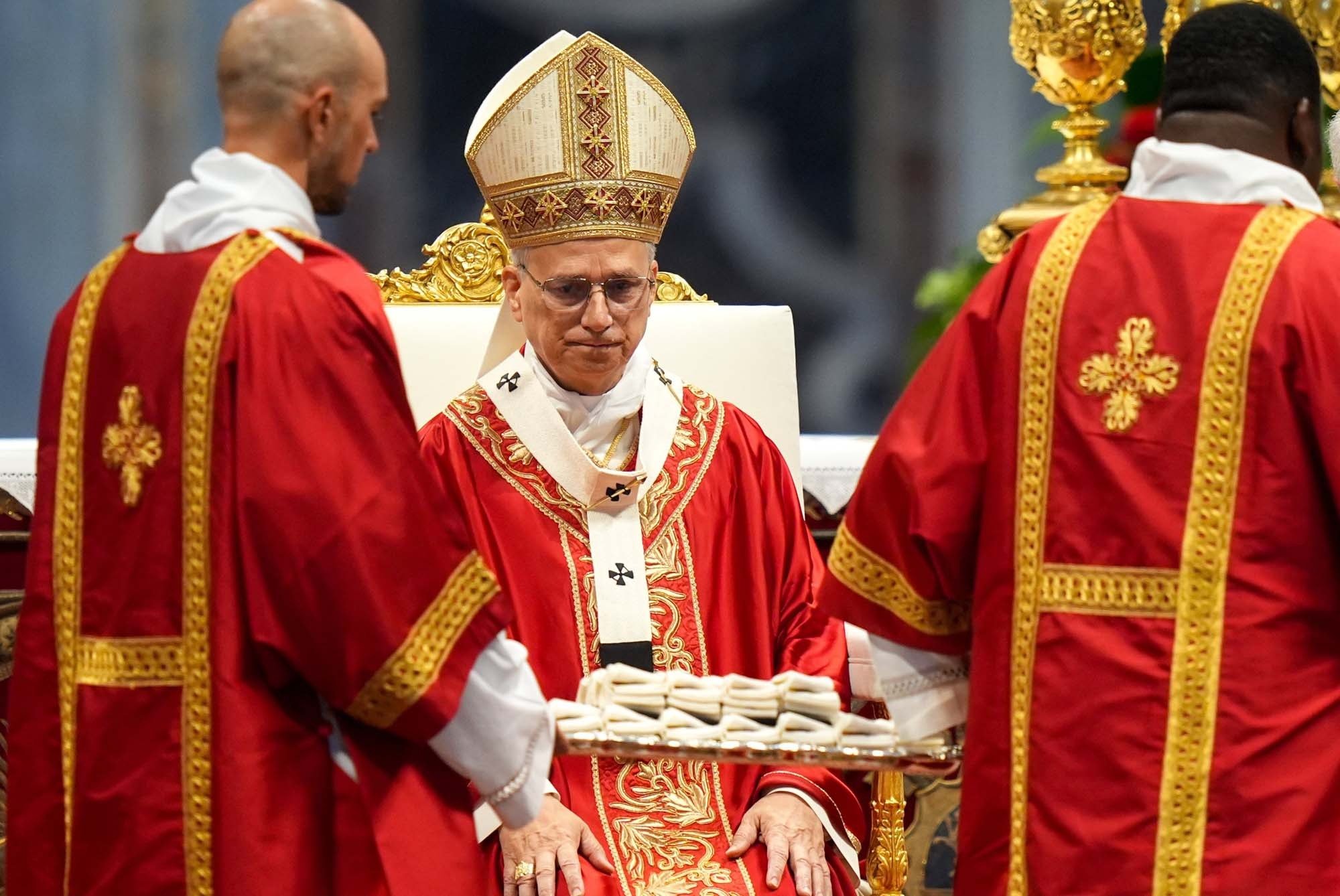 Deacons carry palliums from the crypt above the tomb of St. Peter to be blessed by Pope Leo XIV during Mass for the feast of Sts. Peter and Paul in St. Peter’s Basilica at the Vatican June 29, 2025. (CNS photo/Lola Gomez)According to Vatican News, the pallium, made of lamb’s wool, is a white band measuring about two inches wide. Two equally wide bands, about a foot long, containing small silk-covered lead pieces, extend one in front and one on the back.Six black crosses adorn the pallium and are placed in the front and back, on each shoulder, and on the ends of the pieces hanging in front and back. The crosses on the front, on the back, and on the left shoulder also feature a gold pin, called a spinula (a Latin word meaning a small spine or thorn), symbolizing the three nails of Christ’s crucifixion.In addition, each of the pendants that hang in front and back is tipped with black satin, resembling the hoof of a lamb.Worn over the chasuble, the pallium is the insignia of the office of a metropolitan archbishop.Vatican News reports that every year, on the feast of St. Agnes, two lambs are brought from Tre Fontane, the site of St. Paul’s martyrdom in Rome, to the Basilica of St. Agnes on the Via Nomentana, also in Rome. After they are blessed, they presented to the pope and remain in the care of the sisters who reside at the Basilica of St. Cecilia in Trastevere.Just before Easter, these lambs are shorn and their wool is used to make the pallia for newly appointed Archbishops.Once entirely handmade by the sisters, the sheer number of archbishops in need of a pallia each year has prompted the sisters to use a company to produce them.Each pallium contains a portion of the wool shorn from the two lambs.