
Search
Forty years later, Texas and nation remembers Challenger crew, looks toward the Moon again
-
January 27, 2026
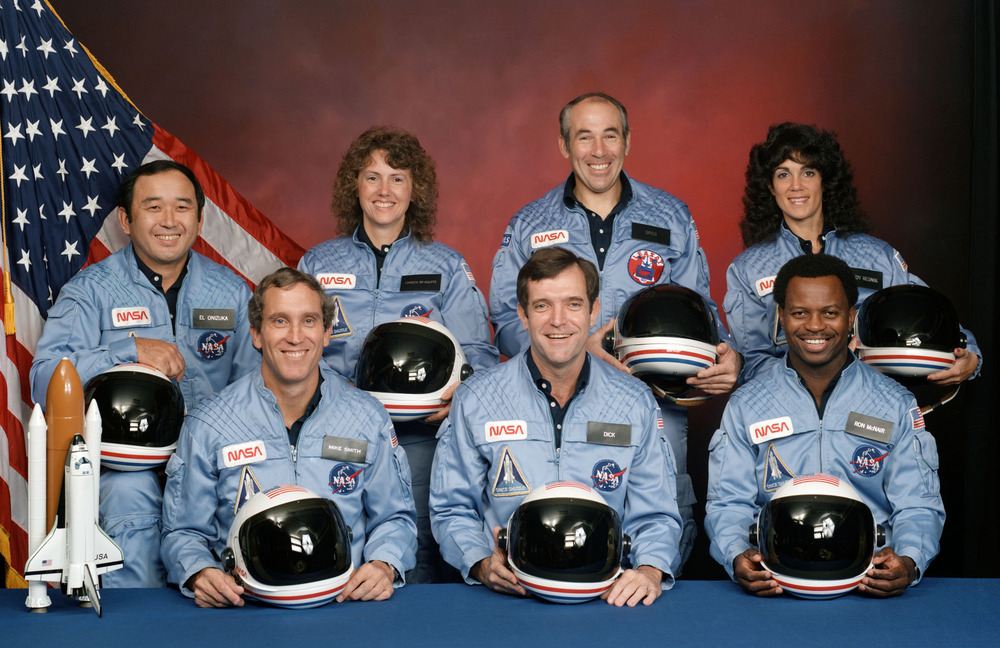 NASA’s STS-51L crew members (front row, from left) Mike Smith, pilot; Francis “Dick” Scobee, mission commander; Ronald McNair, mission specialist; (back row, from left) Ellison Onizuka, mission specialist and astronaut; Teacher-in-Space payload specialist Christa McAuliffe; payload specialist Gregory Jarvis; and astronaut Judith Resnik, mission specialist. The crew died 40 years ago this year when the space shuttle Challenger exploded shortly after liftoff on Jan. 28, 1986.CLEAR LAKE CITY — Forty years after the space shuttle Challenger broke apart shortly after liftoff on Jan. 28, 1986, the nation continues to honor the seven astronauts whose lives and missions shaped a generation of explorers.
The tragedy halted classrooms, stunned viewers across the country and brought millions into shared grief for a crew remembered for their courage, curiosity and commitment to discovery.
Three days after the accident, on Jan. 31, 1986, President Ronald Reagan addressed a mourning nation at Johnson Space Center in Clear Lake City. More than 10,000 people gathered at the famed campus, including Bob Giles, longtime Texas Catholic Herald reporter.
According to Giles, President Reagan called the fallen “seven brave Americans.” His remarks were broadcast nationwide as he recited the stories of Commander Dick Scobee, Pilot Michael Smith, Mission Specialists Judith Resnik, Ronald McNair and Ellison Onizuka, Payload Specialist Gregory Jarvis and teacher Christa McAuliffe, altogether known as the Challenger Seven.
Giles reported that President Reagan urged the country not to abandon its sense of wonder.
“Sometimes things go wrong,” President Reagan said at the memorial, “but we must pick ourselves up and press on again.” He added that the Challenger crew “awakened us to the fact that we are still pioneers” and vowed that “man will continue his conquest of space.”
President Reagan’s words still anchor anniversary observances: “We will always remember them — these artists and teachers and scientists and adventurers.”
In the wake of their loss, he said, “The Challenger crew was pulling us into the future, and we will continue to follow them.” Forty years later, that memory continues to shape national conversations about exploration, sacrifice and the courage required to push beyond the known.A teacher of faith, science
McAuliffe, the first teacher selected to fly in space, was also a practicing Catholic.
The 37-year-old was an active member of St. Peter Parish in Concord, New Hampshire, where she taught religious education in addition to her work as a high school social studies teacher. Her commitment to service, both in her classroom and in her parish, was woven deeply into her identity as an educator.
McAuliffe saw the Challenger mission as a chance to bring space exploration directly to students nationwide.
“I want students to see and understand the special personal side of space,” she said in her application materials.
Her planned lessons, “The Ultimate Field Trip” and “Where We’ve Been, Where We’re Going,” would have reached millions of schoolchildren watching from their classrooms.
Her dual calling as a teacher and a Catholic parish catechist continues to resonate with educators today, especially at Catholic schools around the Archdiocese, who see science and faith not as at odds, but as complementary pursuits rooted in awe, curiosity and service.
Educators across the country continue to use the Challenger story not only as a lesson in scientific risk and engineering reform, but also as a portrait of resilience. The shuttle program resumed flights in 1988 and continued until its retirement in 2011, carrying forward many of the safety improvements born out of the tragedy.
The space shuttle Challenger launch, the one that more than 40 million viewers watched on television, left its heartbreaking mark on classrooms across the country, many of whose school children saw the explosion, according to Giles.
The Challenger tragedy was felt deeply in Houston, where NASA’s astronauts lived and trained. Memorial Liturgies were held in parishes across the Archdiocese of Galveston-Houston.
Then-Bishop Joseph A. Fiorenza offered prayers and comfort, calling the loss “a great sadness for our citizens.”
Across the region, headlights burned in daylight, flags were lowered nationwide and along NASA Road 1, and the Johnson Space Center filled with flowers, cards and messages of condolence. The response showed how closely the nation held its spacefarers: not as distant adventurers, but as neighbors, teachers, parents and heroes.
Then-pope St. John Paul II sent words of “heartfelt solidarity,” calling the Challenger Seven a group of “courageous pioneers in progress of science and man.” The U.S. bishops’ conference offered prayers for the families and for the future of America’s space program.
Today, four decades after the accident, the memory of the Challenger crew remains a defining touchstone in the story of American exploration. Their legacy lives on in classrooms, science fair projects, space camps, museums, scholarship programs and the countless people who were inspired to pursue space science because of them.In memoria 40 years later
For years, NASA has observed an annual Day of Remembrance that commemorates the crews of Apollo 1 and the space shuttles Challenger and Columbia, among other members who have died.
Always held on the fourth Thursday of January, as all three astronaut accidents happened around the end of the month, the annual day was celebrated on Jan. 22 this year. At NASA’s Johnson Space Center in Houston, a commemoration was held that morning at the Astronaut Memorial Grove, which is seen by more than a million visitors every year.
The event featured a moment of silence, a NASA T-38 flyover, Taps performed by the Texas A&M Squadron 17 and a procession placing flowers at Apollo I, Challenger and Columbia memorial trees.Looking Forward: Artemis II prepares the next chapter
Forty years later, as new generations look toward the moon, Mars and beyond, that promise still holds.
The Challenger Seven are remembered not for the moment the world lost them, but for the lives they lived, the dreams they carried and the courage that continues to lift human exploration forward.
NASA is preparing for its next major step in human space exploration: Artemis II, the first crewed mission to travel around the moon in more than 50 years.
NASA is working on planning missions that will test life support systems and confirm that Orion and the Space Launch System are ready for future lunar landings. The agency was targeting possible launches in February 2026. The flight will send astronauts Reid Wiseman, Victor Glover, Christina Koch and Canadian Space Agency astronaut Jeremy Hansen on a lunar flyby intended to pave the way for Artemis III.
Recent preparations include a full rocket rollout to the launch pad at Kennedy Space Center in Florida for a dress rehearsal. This test is one of the final steps before NASA can commit to a launch date. Following a successful launch, Artemis II will mark a significant milestone toward the long-term goal of establishing a human presence on the lunar surface and, eventually, preparing for missions to Mars.