
Search
Voices from The Great Storm: 125 years since the Storm of 1900 that changed Texas forever
-
September 23, 2025
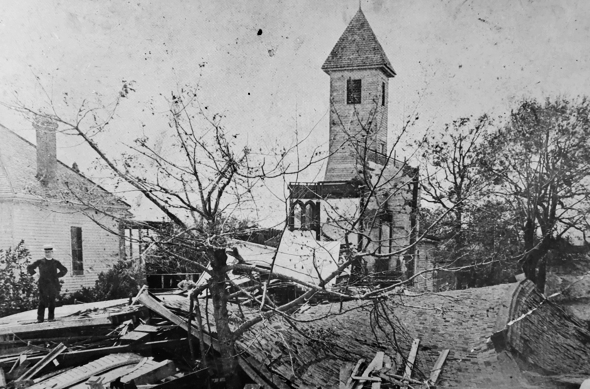 Father Thomas Banfield, pastor of St. Joseph Parish near downtown Houston, searches through the rubble of St. Joseph looking for the church’s tabernacle after the 1900 Storm’s high winds and floods completely destroyed the parish. Only a statue of the Sacred Heart of Jesus survived the destruction. (Photo by the Office of Archives)
On Sept. 8, 1900, Galveston Island was struck by the greatest and most destructive natural disaster ever to hit U.S. soil. That Saturday afternoon, a devastating hurricane charged through the city, wreaking catastrophic destruction and horror as storm surges reached as high as 16 feet, washing over the island.
But because the highest point on the island was only 8.7 feet above sea level, there were few places for residents to run to except for homes and buildings, including several convents, churches and Catholic-run hospitals.
While some stories remain iconic and well-known, such as the heroic acts of the 10 Sisters of Charity of the Incarnate Word who bravely tried to save the 90 children residing at St. Mary’s Orphanage, which was directly on the beach but ultimately died, the voices and stories of others have been lost to time and history.
The Dominican Sisters, who lived at the Sacred Heart Convent located at the intersection of Market and 16th Streets, some seven blocks away from St. Mary’s Cathedral on Moody Avenue, were one of several Catholic places that quickly became refuge points for Galvestonians that day.‘God was so generous’
Among the refugees was a 13-year-old named Helen Bellew, who would later become a Dominican Sister herself, taking the name Sister M. Berchmans Bellew, O.P. In a testimony written years later, Helen described the arrival of the storm while she and her family stayed at their family home, which had survived other minor storms prior.
By late afternoon, their home was the only one left standing, though many windows were shattered and the gallery had separated entirely. Her father helped her, her brother Peter and their mother out of the house to a safe place among the floating debris as her mother tried to protect them from flying slates. Sustained winds of 85 mph and 100 mph wind gusts sent anything and everything flying, including the wind gauges themselves. Today, meteorologists estimate winds actually reached 120 to 140 mph that day.
Her father remained at the house where she last saw him. The three remained together until their floating debris crashed into a two-story house that fell upon them.
Her brother tried to save their mother, and in the chaos, Helen let go of her mother’s hand.
“I never saw her again,” she said. She and her brother were then both knocked unconscious, and when she woke up, she was alone, caught between two boards that were choking her. She called for help and found her sister, Annie, in the pitch-black darkness.
“We stayed together the rest of the night, prayed and even tried to sing hymns,” she said. “After we became exhausted, we said an Act of Contrition and lay down on the debris and went to sleep.”
The next morning, Sept. 10, greeted Helen and Annie with a bright sunny day. In the next few days, she found Peter, and they went to the Dominican Convent of the Sacred Heart to find their older sister, Sister Ignatius, who was a new postulant with the Dominicans. They also visited the Ursuline convent, where they would stay in refuge after the storm.
Orphaned by the storm, Helen said, “God was so generous to provide us with two good, holy Mothers for me,” finding true care and concern in the sisters at the convent.
That Sunday morning, whose sun greeted little Annie and 13-year-old Helen, revealed a horrifying sight.
After finishing high school, she entered the Dominican novitiate on Sept. 8, 1903, the third anniversary of the storm.
A Sept. 12, 1900, report from the Texas Post Opera Glass said that the whole east end from 14th Street and Avenue M had been swept clean by the water. Today, that’s nearly from the Seawall and the entire island east of Sacred Heart Church and the Bishop’s Palace.
The city’s southern beach was pushed two to three blocks inland, and structures of all kinds were swept back and “piled up in an indescribable mass of wreckage,” the report said. In the city center, where most buildings were built securely, “many fell in or were blown over, crushing all” to death.
“Houses floated in all directions and lay in tumbled ruins,” it said. “The four bridges were swept away and telegraphic communications were cut off.”
“All railroad communications were shut off and all wagon and railroad bridges leading to the mainland were gone,” it continued. “There was not a trace of the Orphanage nor its 103 inhabitants.”Father Kirwin’s story
When the storm grew in intensity, St. Mary’s Cathedral took the brunt of the winds but somehow sustained the least damage. A statue of the Blessed Virgin Mary, placed high in 1875, still stood atop its steeple, but the cathedral’s bell had been knocked out of its belltower, tumbling down to the floor.
When Bishop Nicholas Gallagher, who was Galveston’s third bishop, saw debris of all kinds in the air, he turned to Father James Kirwin, rector of St. Mary’s Cathedral, and said: “Prepare these priests for death,” according to Father Kirwin’s testimony in the book “Galveston in 1900.”
In the days after the storm, civic and religious leaders stepped up to lead the recovery efforts, including Father Kirwin. Already a popular leader following his efforts during the 1897 yellow fever epidemic, he helped to organize a public safety committee with the mayor, chief of police and other leaders to initiate a martial law edict.
According to a 1964 Texas Catholic Herald report, out of Galveston’s 40,000 population, 1,000 were without clothing, 5,000 were injured, 10,000 were homeless, and 6,000 had died.
Father Kirwin sent a crew of men to Mother Pauline Gannon, OP, who headed Helen’s Dominican congregation, to help her care for the sick and homeless coming to her convent for aid. Father Kirwin also reported a terrible discovery from western Galveston, where some 43 bodies were discovered dangling from a railroad bridge after the water had subsided.
When the reports and findings of the incredible number of bodies around the island became apparent, he charged groups of men to assist with the recovery of the dead. They were to be put into boats and sent into the Gulf, where they would be buried at sea. Father Kirwin said the men had to be given whiskey to do the work.‘Is it not God’s own house?’
At St. Mary’s University, located next to Sacred Heart Church, was a college school for boys. A testament from a resident at the college shared vain faith in the college’s location above sea level.
By dinner time, the rector found the church “thronged with frightened people,” and it soon became clear that the church was no longer safe, as windows began to fall from the walls, shattering to pieces onto the people below.
Priests removed the Blessed Sacrament from the tabernacle, bringing it to the house chapel. They also removed the statues and vases, leaving the altar linens and everything else to the literal wind. As they left, the resident cried out: “Is it not God’s own house, and is not the storm God’s own storm? He can save, and He can destroy; let His will be done — and it was.”
Two hours later, the waters from the Gulf charged through the small campus.
“I was there in that awful hour and saw how bravely and how generously some men are able to be in a crisis while others stand mute and motionless as if their every sense were deadened,” he said. “That was mad; it spumed and foamed and hoarsely roared and seemed hungry to swallow down everything. It was, above all, so cold!”
Come nightfall, all electricity had been lost, and they discovered the church had fallen.
“There is no longer any hope of safety for 500 huddled [students] of the doomed college,” he said. They gathered in groups to pray a Rosary filled with sudden cries of fear: “Hail Mary, full of grace... O Mamma! Mamma! Save me!”
“Our Lady, for she was the only mother in that hour, must have heard the cries of these poor innocent children, to mothers who were more frightened and helpless than themselves,” he said. The floods forced them to the second floor, where the raucous night still to terrorized them all. The reverend superior promised 1,000 Masses in honor of the Blessed Mother if she helped them stay safe, and according to the testimony, they survived.
Though they made it through the night, they would soon find the grim reality that surrounded them.
“Wreck and ruin stared us in the face on every side,” the resident said. Sacred Heart Church, its physical structure, helped them to survive. Even though it had fallen, had the church not been there, the massive flotillas of debris that had been slamming into buildings all over the island would have destroyed the college.
Their survival may have felt like a gift, but the days after, filled with unspeakable tragedies, felt like a curse: “Galveston! Poor Galveston! Why not call it Graves-town?”The call for aid
An international appeal for aid requested assistance from President William McKinley, all governors, public officials and mayors. Bishop Gallagher pleaded for Catholics across the country to send help, and thousands answered.
According to a diocesan ledger reviewed by Archives and Herald staff, contributions received by the diocese came from as far as Canada, with a donation from the Basilian Fathers in Toronto. Major donations came from the Archdioceses of Boston, New York, Chicago and San Francisco.
Other support came from every corner of the country: Green Bay, Wisconsin; St. Louis; Winona, Minnesota; Connecticut; Montana, all indicative of the quick response and support that came from parishes, dioceses and individuals around the nation.
A gargantuan recovery effort also involved lifting the entire city and island even higher above sea level. Some 500 city blocks and 2,000 buildings were lifted as much as 17 feet above sea level. Among the buildings raised was St. Patrick Church, lifted by hundreds of hand-turned jack screws before new ground was installed below.
Also, city officials and engineers coordinated efforts to build a massive seawall to protect the island from future storm surges, a structure that still stands today. Now a popular site for runners, cyclists and even first dates, the seawall is also home to several memorials to those lost in the 1900 Storm.A memory of faith and prayer
On Sept. 8, 2025, 125 years after the Great Storm slashed Galveston, a group of religious leaders gathered on the Galveston Seawall to pray and honor the lives of those who died in the storm, including the 10 Sisters of Charity.
Sister Deenan Hubbard, CCVI, was among a group of Sisters of Charity of the Incarnate Word who attended the special ceremony. They also placed flowers at the bronze memorial statue, installed in 2000 on the 100th anniversary of the storm, that depicts a family clinging to each other.
The sisters gave a small address, alongside other leaders, and then sang the same French Marian hymn, “Queen of the Waves,” that the 10 Sisters of Charity sang 125 years ago that fateful night as they tried to save the children under their care.
The song ends: “Then joyful hearts shall kneel around thine altar, And grateful psalms re-echo down the nave; Never our faith in thy sweet power can falter, Mother of God, Our Lady of the Wave.”